

Nobody Told Us Sex Was Supposed to Feel Good
On the intersecting forces driving painful sex in women — and why medical intervention alone won’t fix it.
* Throughout this article, the terms 'women/girl' and 'men/boy' refer to people with vulvas and people with penises, respectively, and are used in the context of the research cited. This is not intended to exclude the experiences of intersex, non-binary, or transgender people*
In my work as an Occupational Therapist & Somatic Sexologist, I’ve developed a hypothesis.
It’s not comfortable or simple. But the more women I work with, the more convinced I become that the rates of painful sex and pelvic pain are not primarily a medical problem. I strongly believe they are the compounding result of multiple cultural forces that have been quietly intersecting for decades, and whose combined effect on women’s bodies we are only beginning to reckon with.
Let’s get clear on some of the data first.
The Australian Study of Health and Relationships surveyed 20,091 Australians aged 16 to 69 years. It found that 17% of women had experienced physical pain during intercourse, and that 52% of women had lacked interest in sex, compared to 28% of men. Women were significantly more likely to have unpleasurable sex, and more than 1 in 5 reported difficulty with vaginal dryness. The study noted that some of these difficulties were more pronounced in younger age groups (16–19 years).
Between 8% and 10% of women will experience vulvodynia at some point in their lives, rising to 21% in women aged 18 to 29. Vulvodynia is characterised as chronic vulvar pain in the absence of any identifiable cause. Around 60% of women with symptoms will actually seek help, and of those who do, many consult three or more doctors before receiving a diagnosis.
This is not a niche problem. It describes the routine sexual experience of a large proportion of Australian women and when I look at these numbers alongside everything else I know — from research and what women tell me in clinic — bigger forces seem to be at play and have been swimming underneath the surface for a long time.
My hypothesis starts here: women are experiencing pelvic/genital pain in part because they have never been given the foundational knowledge that would allow them to understand or prevent it.
The full anatomy of the clitoris was not accurately mapped until 1998! In contrast, the appendix had been thoroughly documented for over a century, and erectile dysfunction had been a recognised medical diagnosis since the 70s, with dedicated research funding and pharmaceutical intervention. The organ central to female sexual response was, apparently, less urgent.
Professor Helen O’Connell (who happened to be Australia’s first female urological surgeon) noticed during her medical training in the 1980s that her textbooks contained no description of the clitoris at all. The penis, meanwhile, had multiple detailed chapters including full nerve and vascular anatomy. What she found was that the clitoris is not a small external structure, a nub or a button. It is large, complex, and almost entirely internal, with legs extending inside the body, wrapping around the vaginal canal with erectile tissue that engorges with arousal; a process that is physiologically similar to a penile erection. The tiny visible portion is approximately 10% of the total structure.
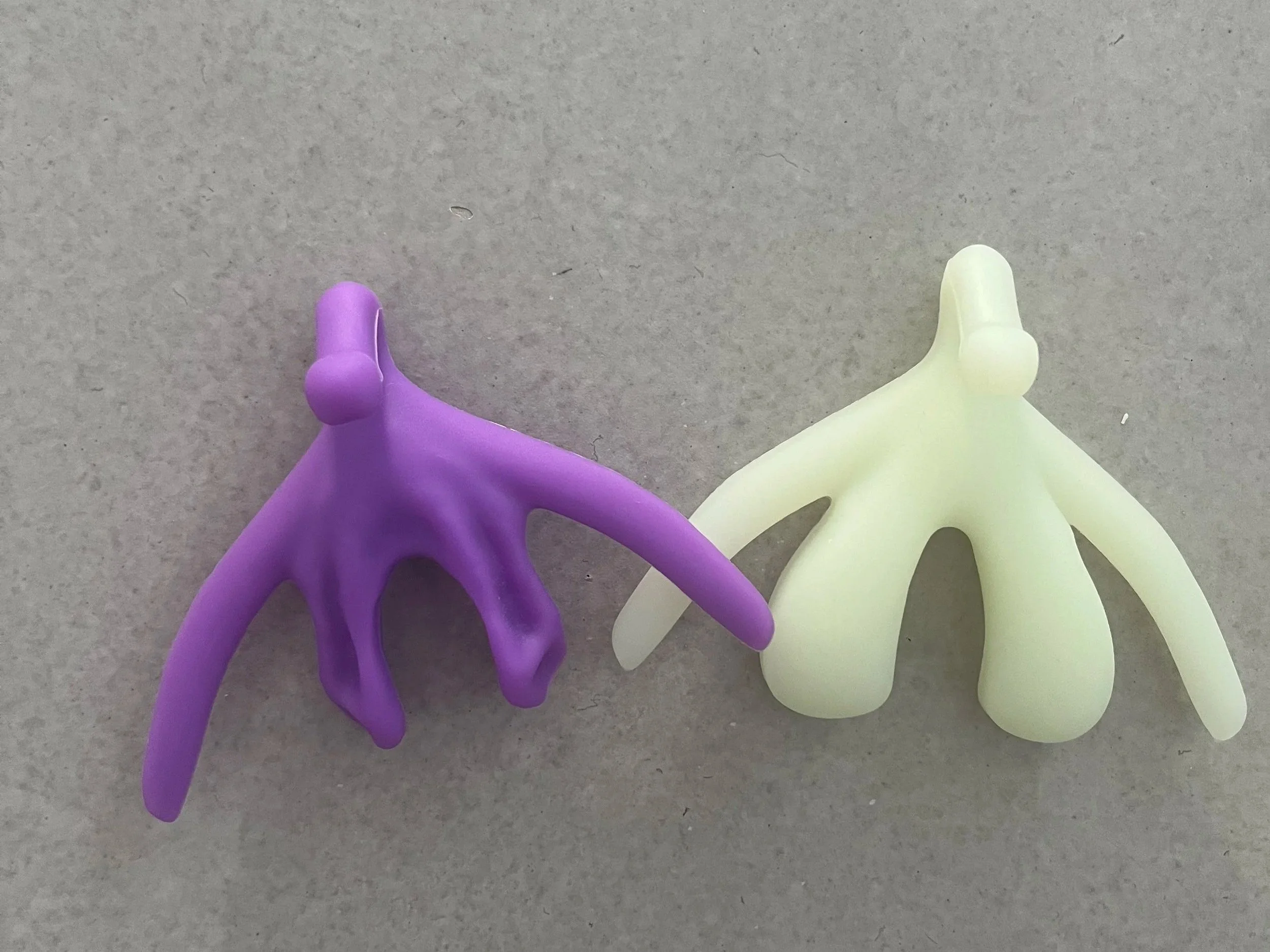
Non-aroused (left) and aroused (right). This is what readiness actually looks like.
The neglect didn’t stop at the clitoris. Big, deep, sigh. We still routinely use the word “vagina” to refer to the entire external female genitalia. Conflating vulva and vagina isn’t a minor semantic error; it reflects and reinforces a broader pattern in which female anatomy is understood primarily in terms of its function for penetration or reproduction.
Conversely, men receive physiological reinforcement of what arousal feels like through erections and the body provides its own feedback loop from adolescence onward. For women, arousal is different as it's internal and often subtle — warmth, tingling, pulsating or fullness sensations. I don't know about you, but I certainly wasn’t taught to attune to those sensations, to notice them and understand what they mean. Subsequently, women can move through years of sexual experience with very little felt sense of what arousal actually feels like in their own body.
Why does this matter for pain? Because female sexual arousal is not just about pleasure. It is the physiological process that prepares the body for comfortable, penetrative sex. When a woman is genuinely aroused, the vulva engorges, the vaginal walls expand, lubrication occurs, and the tissue becomes receptive. When penetration happens before the body is ready, the result is friction against unprepared tissue. We have an entire medical system and history of sex education built on the omission of the organ central to female arousal. And so, women enter sexual experiences physiologically underprepared; they experience pain and because they’ve never been told otherwise, they believe “this is just how sex is…painful and not that good.”
Into this knowledge vacuum stepped pornography. And this is where my hypothesis gets more layered.
I want to be clear: the issue is not pornography’s existence, but rather what happens when it becomes the primary source of sexual education for an entire generation, which is increasingly exactly what has occurred. A nationally representative US survey found that 1 in 4 young adults aged 18 to 24 named pornography as their most helpful resource for learning how to have sex. Studies examining the content of mainstream pornography have found that physical aggression is present in 35% to 88% of scenes, depending on the platform and sample, with the most commonly depicted acts being gagging, slapping, and hair-pulling. In the overwhelming majority of these scenes, the aggression is directed at women, who respond with expressions of pleasure.
Pornography depicts women achieving orgasm through penetration alone — no warm-up, no communication of wants/needs, no clitoral stimulation required. When oral sex appears at all, it follows a predictable order: male pleasure first, female pleasure briefly and secondarily, if at all. Research by Frederick et al. (2018) gives us the numbers. When penetration alone occurs, women orgasm 35% of the time. Add deep kissing (57%), oral sex (71%), and manual stimulation (77%), and that rises to 80% orgasm rate. Penetration, the act pornography frames as the “main event” is statistically the least reliable route to female orgasm. It's not only about which sexual acts occur. Another study on the female orgasm (2022) found that partner effort (whether a woman's partner actively tried to help her orgasm) was the strongest predictor of whether she did orgasm.
Men orgasm 95% of the time in heterosexual sex.
Lesbian women orgasm 85% of the time.
Which tells us something important: the orgasm gap isn't anatomical. It's attentional.

Importantly, these messages have been subliminally fed to us in mainstream media over a century. Cue the spontaneously passionate nighttime sex scene where clothes are ripped off, penetration occurs immediately, and female orgasm happens within the final seconds. It is only in the last few years that films like Poor Things and Babygirl have been celebrated for depicting female pleasure as actually centred on women’s bodies, and the response has been to treat them as daring and transgressive. The fact that accurately depicting female sexual pleasure still reads as revolutionary says everything about what the default has been.
The result is a generation of young people who have absorbed a template for sex that is physiologically inaccurate for women’s bodies. And not just inaccurate, but actively counterfactual in ways that produce harm. Because when a young woman has learned (through thousands of hours of implicit messaging) that her body “will” respond this way and then she will interpret her own body’s failure to produce this response as a personal problem rather than a factual error.
She won’t slow things down.
She won’t name the discomfort.
She’ll push through because the script says this is what women do and the script says they enjoy it.
Now I come to what I perceive as the deepest layer: the way women have been taught to relate to their own desire.
Permission to Want
This is the part of my hypothesis that I find most important, and perhaps most under-discussed. Operating beneath the anatomy gap, the orgasm gap and the pornography problem is something more fundamental — a cultural architecture that has consistently positioned women as objects of desire rather than desiring subjects in their own right. From the earliest age, girls receive a consistent message about where their sexual value lies: in being attractive, being chosen, and being a good experience for someone else. Their own desire, what they want, what feels good to them, what their bodies actually need, is almost, entirely absent from the picture.
Peggy Orenstein spent years interviewing teenage girls about sex for her 2016 book Girls & Sex, and one finding has stayed with me. Girls measured satisfying sex as sex that wasn't painful and that their partner enjoyed. Boys measured satisfying sex as sex in which they orgasmed. Girls described themselves as learners rather than yearners, focused on performing adequately, pleasing their partner, getting it right. Not on what they themselves wanted or felt.
I find that equal parts sad and enraging.
Because when girls are taught to be desirable rather than desiring, the outsourcing of their own experience becomes total. So internalised, and so early, that most don't recognise it as a pattern; they've never been given a different script to compare it to.
And this isn't just a cultural problem, it's a physiological one. Anxiety, self-monitoring, and suppressing your own experience during sex are all associated with increased pain and reduced arousal in women. When a woman is focused on performing rather than feeling, the conditions for comfortable sex are actively undermined.
The body follows the mind.
If the mind is elsewhere, the body braces.
What I keep coming back to is how these forces compound each other. A woman who doesn’t know her own anatomy enters sex without the knowledge to ask for what her body needs. Pornography has given her a script in which her needs are irrelevant to the narrative. A culture of desirability-over-desire has taught her that her role is to be pleasing, not pleased. The orgasm gap has normalised her dissatisfaction to the point where she no longer fully expects otherwise. And when pain occurs, she absorbs it, because she has been well-trained to do so.
These are not separate problems. They are the same problem, seen from different angles.
This is the work I do with women, tracing pain back through the layers to what the body has been carrying, what it was never taught, what it quietly learned to accommodate that it was never supposed to. The body remembers. Pain is protective.
In practice, this can look like helping women come back to their own bodies and pleasure, understanding how their arousal systems work, reconnecting/discovering their desires and learning to feel, develop and communicate embodied boundaries.
If this article lands somewhere for you, I'd love to hear from you. Book a free 15-minute connection call and let's talk.
References
Bridges, A. J., Wosnitzer, R., Scharrer, E., Sun, C., & Liberman, R. (2010). Aggression and sexual behavior in best-selling pornography videos: A content analysis update. Violence Against Women, 16(10), 1065–1085.
Fritz, N., Malic, V., Paul, B., & Zhou, Y. (2020). A descriptive analysis of the types, targets, and relative frequency of aggression in mainstream pornography. Archives of Sexual Behavior, 49(8), 3041–3053.
Frederick, D. A., John, H. K. S., Garcia, J. R., & Lloyd, E. A. (2018). Differences in orgasm frequency among gay, lesbian, bisexual, and heterosexual men and women in a U.S. national sample. Archives of Sexual Behavior, 47(1), 273–288.
Harlow, B. L., Wise, L. A., & Stewart, E. G. (2001). Prevalence and predictors of chronic lower genital tract discomfort. American Journal of Obstetrics and Gynecology, 185(3), 545–550.
O’Connell, H. E., Sanjeevan, K. V., & Hutson, J. M. (2005). Anatomy of the clitoris. Journal of Urology, 174(4), 1189–1195.
Orenstein, P. (2016). Girls & Sex: Navigating the Complicated New Landscape. New York: Harper Collins.
Richters, J., Yeung, A., Rissel, C., McGeechan, K., Caruana, T., & de Visser, R. (2022). Sexual difficulties, problems, and help-seeking in a national representative sample: The Second Australian Study of Health and Relationships. Archives of Sexual Behavior, 51(3), 1435–1446.
Rothman, E. F., Beckmeyer, J. J., Herbenick, D., Fu, T. C., Dodge, B., & Fortenberry, J. D. (2021). The prevalence of using pornography for information about how to have sex: Findings from a nationally representative survey of U.S. adolescents and young adults. Archives of Sexual Behavior, 50(2), 629–646.
Wetzel, M. E., Leavitt, C. E., James, S. L., & Willoughby, B. J. (2022). Sexual expectations and women’s orgasm: The role of orgasm expectation and likelihood. Sex Roles, 86, 616–630.